
In The Sunday Times, David Smith described the fiscal devolution measures as “perhaps the most important thing announced in the budget but the one eliciting the least comment”.1 I agree with him. Beneath a Budget that set few pulses racing, the government has begun to build the fiscal machinery for devolution in England, as part of a wider programme it calls Rewiring the State.
My purpose here is to bring that machinery into view, to ask whether it can lead to civic growth, and to identify the signs to watch.
What the Budget delivered
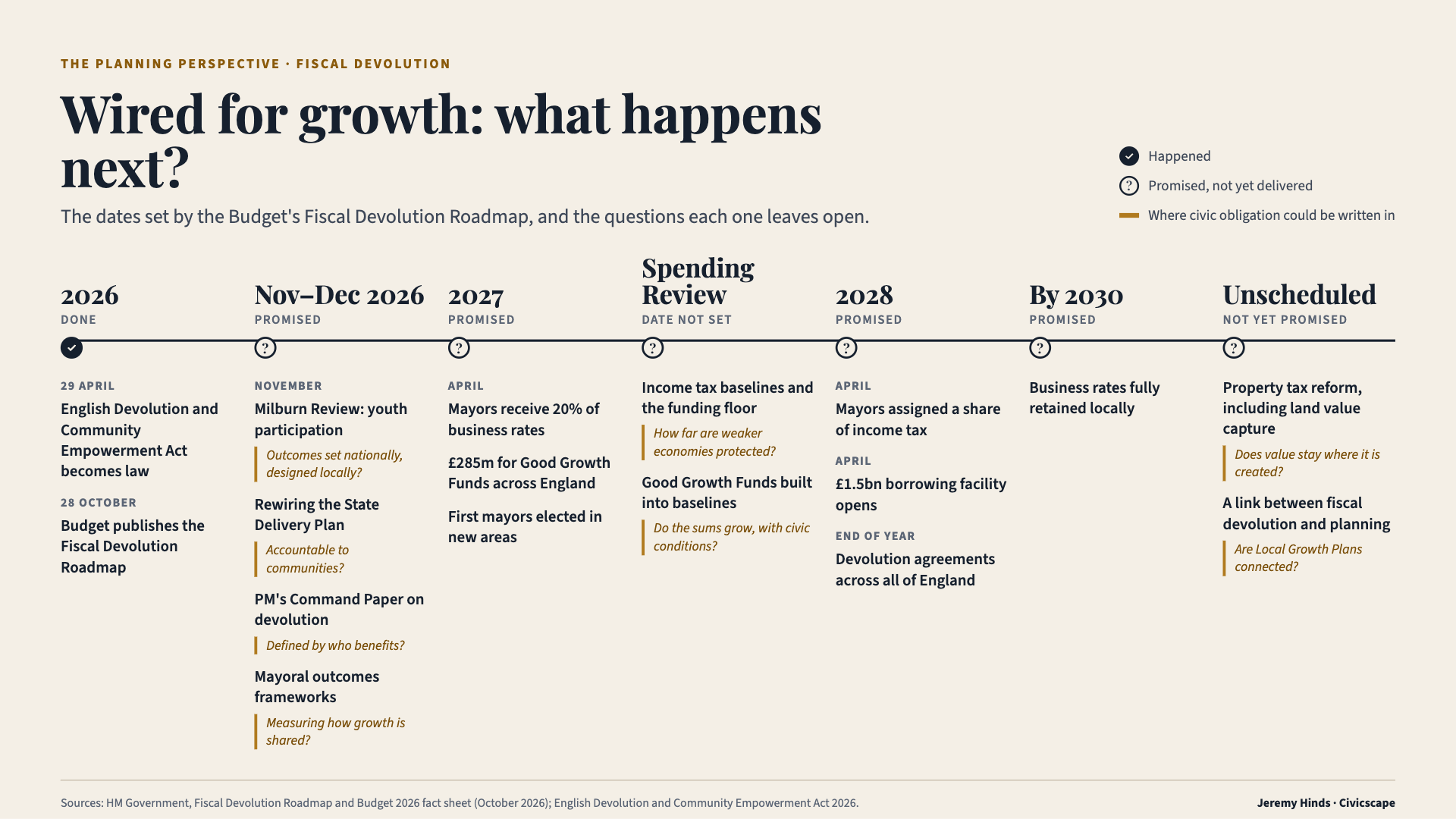
The Budget’s Fiscal Devolution Roadmap2 moves mayoral strategic authorities away from grant funding and towards revenue of their own: a share of business rates from 2027, and a share of basic-rate income tax from 2028.
Alongside these, £285m is allocated in 2027-28 for Good Growth Funds across England: £165m for areas with a mayor and £120m of incubator capital for areas moving towards devolution.3 A £1.5bn borrowing facility for mayoral authorities follows in 2028. Against the scale of the Budget, the sum looks modest. That may explain why it has attracted so little attention. In my view, its size is a poor guide to its significance.
The model it borrows from
In May I wrote in The Planning Perspective about the model Andy Burnham built as Mayor of Greater Manchester.4 He calls it Manchesterism. I called it civic growth, because its principle can travel in a way a place name cannot.
The model has three stages. Concentrated investment creates growth in a few places. That growth then spreads outwards, weakening with distance. Civic growth is the third stage: deliberate intervention to extend the benefits to places growth has not reached, conditioned by tests of who benefits. Greater Manchester’s Good Growth Fund makes its Good Employment and Good Landlord Charters conditions of public investment. Its Mayoral Development Corporations each respond to the needs of their own place. Public support carries civic obligation, written in at the point of investment.
Much commentary presents this as an attempt to reverse the Thatcher legacy. I think that misreads it. Civic growth starts from the limits of the neoliberal model and builds on the growth it created. Fiscal devolution has the same character: part restoration of local taxes lost in 1990, part something new in England. Its ambition goes further than either. According to Centre for Cities, the UK is the most fiscally centralised country in the G7, with over 95% of tax revenue going to central government.5 The Roadmap begins to move England from central grant to local revenue. In my view, that shift is the most radical thing in this Budget. Big Bang, forty years and a day before this Budget, changed how capital moved through the City of London and drew it towards the centre. This is a Big Bang of a different kind, moving fiscal power out of the centre and towards the places where growth is meant to land.
What travelled and what didn’t
The Roadmap carries much of Greater Manchester’s approach to the rest of England. Good Growth Funds, retained revenue and borrowing give mayors resources of their own to direct. The instruments of civic growth have gone national.
The civic obligation has not gone with them. The Roadmap says mayors “will be able to choose where to target funding”, with “maximum local flexibility”. It attaches no conditions on employment standards, landlord standards or social value of the kind Greater Manchester applies.
The Budget introduces new fiscal powers in tandem with new devolved administrations. Greater Manchester’s councils have worked together for decades, and its approach to civic growth has developed over that time. Many of the areas now gaining powers are new, and some will elect their first mayor in 2027 or 2028. Their politics will need time to bed in. As they do, they may come to define civic growth for their own places.
A fiscal tool first; now what to look for
A Budget is a fiscal instrument, scrutinised on fiscal terms. It is a natural place to build machinery and a poor place to set out a political settlement. Read that way, the Roadmap reflects a decision about sequence. It defers accountability, and detail on how devolved revenue is spent, to what the government calls its Rewiring the State Delivery Plan, due by the end of the year.
The scale of the sums points the same way. Greater Manchester’s Good Growth Fund, pooling public, pension and private capital, launched with £1bn of investment capacity. The national £285m is seed funding. The former Regional Development Agencies were found to return around £4.50 in economic output for every £1 invested.6
I read the Budget as taking two tentative steps. The first is fiscal: modest sums that allow the model to show what national money can achieve when spent locally, with larger funding to follow. The second is political: the politics of civic growth is held apart, to be settled outside the forensic scrutiny a Budget attracts. The civic growth agenda has not been lost. The signs that it is being written in are these:
Before the end of 2026
- The Rewiring the State Delivery Plan: does accountability run to communities, as well as to Whitehall?
- The Prime Minister’s Command Paper on devolution: is the purpose of devolution defined by who benefits from growth?
- Outcomes frameworks for mayoral authorities: do they measure how growth is shared, alongside how much there is?
At the next Spending Review
- Income tax baselines and the funding floor: how far are weaker economies protected?
- Good Growth Fund allocations: do the sums grow, and does guidance encourage civic conditions?
Not yet timetabled
- Property tax and planning: does land value capture feature, and are Local Growth Plans linked in?
The fuse is lit
Most commentary found little in this Budget to excite. I think that misjudges it. The measures are modest and were presented quietly. In my reading, that is deliberate. The fuse on fiscal devolution has been lit, and few have noticed.
The Delivery Plan, the outcomes frameworks and the Spending Review will show what the charge has been packed with. If civic obligation is part of it, the result will be seen well beyond Greater Manchester. There will be fireworks.
What should follow
Local leaders and the planning profession should help shape the outcomes, accountability and funding decisions still to come, while they remain open.
Postscript
2 November 2026
Since this piece was written, The Times has reported what may be the first sign of the framework taking shape.7 Alan Milburn’s review of youth participation, due this month, is expected to set a national framework, including a youth guarantee, with “expected outcomes” but leave “the design of systems to local leaders”. Combined and local authorities, including those led by mayors, would receive upfront funding from the Treasury. The Times links the approach to income tax assignment, which gives mayors a direct stake in getting young people into work.
That is the pattern this piece anticipates: outcomes set nationally and delivered locally, with a fiscal incentive attached. The motive is partly fiscal too, since ministers expect it to reduce the welfare bill. The test is whether those outcomes measure who benefits, and whether the funding is enough to meet them.
Notes
-
David Smith, economics editor, The Sunday Times, “Will giving money and power to mayors transform economic growth?”, thetimes.com, 31 October 2026. ↩︎
-
HM Government, Fiscal Devolution Roadmap, October 2026. https://assets.publishing.service.gov.uk/media/6ae103627b7111c482d80a99/Fiscal_Devolution_Roadmap.pdf ↩︎
-
HM Government, Budget 2026 Fact Sheet: Delivering for Every Region, October 2026. https://www.gov.uk/government/news/budget-2026-fact-sheet-delivering-for-every-region ↩︎
-
Jeremy Hinds, “Why Manchester: Civic Growth and Why Labour Says They Need It”, The Planning Perspective, May 2026. ↩︎
-
Centre for Cities, Fiscal devolution for London, July 2026, chapter “The UK is very fiscally centralised, limiting growth”. https://www.centreforcities.org/?p=56455 ↩︎
-
PricewaterhouseCoopers for the Department for Business, Enterprise and Regulatory Reform, Impact of RDA spending: National report, March 2009. ↩︎
-
The Times, 2 November 2026, on the Milburn Review of youth participation. ↩︎
Key concepts
- Civic growth
- Growth conditioned by civic obligation, extended to places growth has not reached.
- Fiscal devolution
- Moving public funding from central grant to revenue raised and kept locally.
- Staged model
- Concentrated investment, then outward spread, then civic growth.
About the author
Jeremy Hinds is a chartered town planner (MRTPI) with over twenty-five years of experience in planning policy, housing delivery, development viability, and land acquisition.
Related pieces